

Sustainability · 2025
In this section53 topics
- Sustainability Policy2 items
- Sustainability Goals & UN SDGs3 items
- Policy Review3 items
- Business Value Chain1 item
- Stakeholder Analysis1 item
- Environmental Policy & Guidelines3 items
- Environmental Policy Review3 items
- Energy Management — Overview1 item
- Energy — Plan & Guidelines2 items
- Energy — Electricity Consumption1 item
- Energy — Fuel Consumption1 item
- Energy — Targets2 items
- Energy — Performance & Outcomes2 items
- Water Management — Overview1 item
- Water — Plan & Guidelines2 items
- Water — Withdrawal, Discharge & Consumption1 item
- Water — Targets2 items
- Water — Performance & Outcomes2 items
- Waste — Plan & Guidelines3 items
- Waste — Generation, Disposal & Recycling1 item
- Waste — Targets1 item
- Waste — Performance & Outcomes2 items
- GHG — Plan & Guidelines2 items
- GHG — Emissions1 item
- GHG — Emissions Verification1 item
- GHG — Principles & Standards1 item
- GHG — Targets1 item
- GHG Targets — Net Zero1 item
- GHG Targets — Other Targets1 item
- GHG — Performance & Outcomes2 items
- Environmental Legal Incidents1 item
- Other Environmental Management1 item
- Social Policy & Guidelines3 items
- Social Policy Review1 item
- Social — Principles & Standards Practised1 item
- Human Rights Due Diligence2 items
- Employees — Plan & Guidelines3 items
- Employees — Workforce2 items
- Employees — Remuneration & Provident Fund2 items
- Employees — Training & Development2 items
- Employees — Occupational Health & Safety2 items
- Employees — Labour Relations2 items
- Employees — Employee Representation2 items
- Employees — Targets2 items
- Employees — Performance & Outcomes2 items
- Customers — Plan & Guidelines3 items
- Customers — Satisfaction Results1 item
- Customers — Targets2 items
- Customers — Performance & Outcomes2 items
- Community & Social — Plan & Guidelines3 items
- Community & Social — Targets1 item
- Community & Social — Performance & Outcomes2 items
- Law Violation Incidents1 item
Sustainability Policy
Has a Sustainability Policy
Yes
Policy Description
Chewathai Public Company Limited and its affiliated companies (the “Company”) operate a real estate development business with the objective of delivering products and services that exceed customer satisfaction and maximizing wealth for shareholders.
The Company conducts its business with emphasis on Corporate Social Responsibility (CSR) and Sustainable Development (SD), operating responsibly under the ESG (Environmental, Social, Governance) framework. It focuses on creating balanced development across all dimensions, recognizing that businesses face various challenges and must continuously evolve to achieve stable and sustainable growth.
The Company aims to establish a sustainable development process that ensures balance across four key dimensions as follows:
Economic Dimension
To develop diverse products that respond to customer needs, enhance competitiveness, and achieve sustainable growth.
Social Dimension
To improve the quality of living within society and promote greater well-being and positive mental health.
Environmental Dimension
To utilize resources efficiently and responsibly while minimizing environmental impacts to the greatest extent possible.
Governance Dimension
To establish an effective corporate governance structure and system, including oversight, monitoring, and evaluation processes, ensuring that all parties operate in alignment and in the same strategic direction.
Sustainability Goals & UN SDGs
Has Sustainability Goals
Yes
Goals Description
Chewathai Public Company Limited has established a five-year sustainability roadmap (2024–2028) to align with its business strategy, the Sustainable Development Goals (SDGs), and to effectively respond to stakeholder expectations.
Better Environment
Creating a better environment by supporting environmental initiatives and establishing operational standards to control construction quality. The Company emphasizes the selection of environmentally friendly construction materials and systematic management of construction waste to ensure proper processing and minimize waste generation.
Key targets include:
Reducing greenhouse gas emissions in line with the Company’s Net Zero target within the specified timeframe
Increasing the proportion of renewable energy used in production processes
Reducing waste generation and water consumption in production processes
Better Society
Creating a better society by being attentive, listening to, and equitably responding to the needs of all stakeholders.
Key initiatives include:
Supporting workforce skill development and promoting fair employment opportunities
Enhancing employee health and workplace safety
Implementing community development projects to improve quality of life
Better Governance
Building a stronger organization by instilling ethical values across the Company and conducting business with transparency, fairness, and accountability in all dimensions.
Key commitments include:
Ensuring 100% of employees receive training on anti-corruption and unfair competition practices
Zero cases of violations of the Company’s Code of Conduct, policies, and regulations
Implementing supplier assessments covering business ethics, code of conduct, and anti-corruption policies
Conducting corruption risk assessments covering 100% of relevant operations
Zero legal violations related to unfair competition
UN Sustainable Development Goals
| SDG Goal |
|---|
| Goal 3 Good Health and Well-being |
| Goal 4 Quality Education |
| Goal 5 Gender Equality |
| Goal 8 Decent Work and Economic Growth |
| Goal 9 Industry, Innovation and Infrastructure |
| Goal 11 Sustainable Cities and Communities |
| Goal 13 Climate Action |
| Goal 17 Partnerships for the Goals |
Policy Review
Policy Reviewed This Year
Yes
Policy Changed This Year
Yes
Review Details
The Board of Directors’ Meeting No. 6/2025, held on 13 November 2025, passed a resolution approving the review of the Company’s Sustainability Policy. The key points are summarized as follows:
Environmental Aspect:
The Company is committed to minimizing environmental impacts across all operational processes. It aims to develop environmentally friendly real estate projects, with emphasis on efficient energy use, water resource management, waste and waste reduction, and biodiversity conservation to promote long-term environmental sustainability.Social Aspect:
The Company places importance on respecting human rights, providing a safe working environment, engaging with communities, maintaining strong relationships with stakeholders, selecting ethical business partners, and being responsible to customers in order to enhance quality of life and social well-being.Corporate Governance Aspect:
The Company adheres to good corporate governance principles by conducting business with transparency, accountability, ethical standards, and responsibility toward all stakeholders, in order to build trust and ensure sustainable growth of the organization.
Business Value Chain
Value Chain Description
Managing impacts on stakeholders throughout the value chain is a crucial mechanism for systematic ESG implementation. Organizations must identify, assess, and manage risks from upstream to downstream, along with setting clear KPIs and monitoring systems. Such actions help reduce strategic risks, build confidence, and enhance long-term sustainable competitiveness.
The company operates a real estate development business with the following key value chain:
1. Land Acquisition (Land Acquisition)
-
Consider suitable locations, not within conservation or protected areas
-
Assess environmental and legal risks
2. Design (Design & Development)
-
Design according to Green Concept principles
-
Select environmentally friendly materials
-
Consider reducing energy consumption and greenhouse gas emissions
-
Procurement (Procurement)
-
Utilize the CHEWA PROCUREMENT system for transparency
-
Control costs and manage partners fairly
-
Promote partners with ESG approaches
-
Construction (Constructuon)
-
Control PM10 dust to meet standard criteria (100%)
-
No environmental law violations
-
Efficiently manage waste, water, and energy
-
Sales and Transfer (Sales & Transfer)
-
Utilize the CHEWA CONNECT system for customer management
-
Customer satisfaction 80%
-
After-Sales Service and Community Management (After-Sales & Community Management)
-
No environmental complaints
-
No human rights and labor complaints
-
Promote good relationships with communities
The company sets KPIs for environmental, social, and governance aspects and continuously monitors performance.
Stakeholder Analysis
Stakeholder Analysis
| Stakeholder Type | Stakeholders | Stakeholder Expectations | Response to Expectations | Communication Activities |
|---|---|---|---|---|
| Internal stakeholders | 2921 · Description: Employees | - Job security
- Appropriate compensation and benefits
- Continuous development and training
- Safe working environment
- Fair and non-discriminatory treatment | - 100% of employees completed business ethics training
- Average training hours: 10.76 hours/person (exceeding the 5-hour target)
- Employee engagement level: 78.61%
- No complaints regarding labor or human rights | 2941 · Description: Online Communication · 2942 · Description: Internal Meeting · 2945 · Description: Complaint Reception · 2946 · Description: Employee Engagement Survey · 2948 · Description: Training / Seminar |
| Internal stakeholders | 2897 · Description: Board of director | - Business Operations in Accordance with Good Governance Principles
- Effective Risk Management
- Sustainable Growth | - Define ESG and Net Zero 2598 policies
- 100% anti-corruption training
- No cases of unfair competition | 2942 · Description: Internal Meeting · 2949 · Other name: Annual Performance Report · Description: Others · 2949 · Other name: Sustainability Report · Description: Others |
| External stakeholders | 2923 · Description: Customers | - Project Quality and Safety
- Prompt and Transparent Service
- After-Sales Service | - Customer satisfaction at 80% (exceeding the target of 75%).
- Utilized the CHEWA CONNECT system for customer relationship management.
- No complaints regarding personal data. | 2941 · Description: Online Communication · 2945 · Description: Complaint Reception · 2947 · Description: Satisfaction Survey |
| External stakeholders | 2899 · Description: Suppliers · 2918 · Description: Contractors | - Fairness and transparency in procurement
- Timely payments
- Long-term cooperation | - Utilize CHEWA PROCUREMENT system to enhance transparency
- No instances of trade disputes
- Promote business partners adhering to ESG principles | 2949 · Other name: Online Procurement System · Description: Others · 2949 · Other name: Partner Meeting · Description: Others · 2949 · Other name: Contracts and Official Documents · Description: Others |
| External stakeholders | 2931 · Description: Government agencies and Regulators | - Compliance with Laws and Regulations
- Data Transparency | - No cases of legal violations
- Information disclosure through reports
- Annual and One Report
- Preparation of Carbon Footprint for base year 2025 | 2949 · Other name: Reporting in compliance with government agency requirements · Description: Others · 2949 · Other name: Legal Audit · Description: Others · 2949 · Other name: Submission of One Report · Description: Others |
| External stakeholders | 2902 · Description: Community · 2928 · Description: Society | - No environmental impact
- Participation in community development
- Transparency in project implementation | - 100% control of PM10 dust
- No environmental complaints
- No cases of environmental law violations | 2940 · Description: Social Event · 2945 · Description: Complaint Reception · 2949 · Other name: Pre-construction briefing · Description: Others |
Environmental Policy & Guidelines
Has an Environmental Policy
Yes
Policy Description
The company recognizes its social responsibility in conserving natural resources and energy to mitigate the impacts of climate change. Therefore, it has established an environmental policy consistent with its business operations, aiming to foster cooperation among all employees to participate in environmental preservation and utilize resources efficiently. The company strictly adheres to environmental laws and is committed to managing biodiversity by conducting Environmental Impact Assessments (EIA) and strictly implementing mitigation measures, as well as consistently managing projects under environmental prevention and mitigation measures. In design and construction, the company considers using environmentally friendly materials, selecting materials from sources that do not impact biodiversity, and promoting the use of renewable energy, such as installing solar panels, to reduce greenhouse gas emissions. Furthermore, it promotes environmental activities both within and outside the organization to raise environmental awareness, manages green spaces in projects, and installs electric vehicle charging stations to promote the use of clean energy.
In addition, the company supports product reuse and maintains the workplace environment by organizing Big Cleaning Day activities to manage resources appropriately and reduce environmental impact.
Environmental Guidelines
| Guideline |
|---|
| Electricity Management |
| Water Management |
| Waste Management |
| Biodiversity Management |
| Greenhouse Gas and Climate Change Management |
| Air Quality Management |
Environmental Policy Review
Policy Reviewed This Year
No
Review Details
The company systematically establishes environmental policies and practices covering energy management, greenhouse gas emission reduction, water and waste management, and pollution control, with the Board of Directors overseeing policy and setting clear targets.
The company has set 2025 as the base year for greenhouse gas emissions and aims for Net Zero greenhouse gas emissions ( Net Zero) by 2055, with short-term and medium-term targets as follows:
|
Year 2026 |
Reduce greenhouse gas emissions by 5% (Scope 1,2) |
|
Year 2027 |
Reduce greenhouse gas emissions by 10% (Scope 1,2) |
|
Year 2034 |
Reduce greenhouse gas emissions by 40% (Scope 1,2 and 3) |
|
Year 2055 |
Net Zero greenhouse gas emissions (Scope 1,2 and 3) |
Policies & Guidelines Changed
| Change |
|---|
| Greenhouse Gas and Climate Change Management |
Energy Management — Overview
Introduction
The company establishes an energy management plan focusing on
-
The use of high-efficiency electrical appliances
-
Employee energy conservation campaign
-
Regular inspection and maintenance of electrical systems
-
Annual monitoring and evaluation of energy consumption
Energy — Plan & Guidelines
Has an Energy Management Plan
Yes
Plan Description
Guidelines for energy and electricity management within office buildings.
-
Setting appropriate on/off times for lights, air conditioners, and all electrical appliances in the office to match usage periods, such as turning off air conditioners 30 minutes before breaks or end of work, and switching off and unplugging electrical appliances when not in use, such as computers and printers.
-
Select energy-saving equipment and light bulbs certified by industrial product standards, and promote energy conservation, such as using LED bulbs throughout the office, regularly cleaning air filters, and setting appropriate air conditioner temperatures. The 5S committee helps publicize that all employees are responsible for surveying and inspecting electrical equipment to ensure it is always ready for use.
-
Reorganize the office layout and seating areas, and establish regulations allowing employees to work at project sites for at least 2 days a month, in order to reduce electricity consumption and air conditioner usage within the office.
-
Promote and instill awareness and importance in everyone to collectively monitor electricity usage within the office to ensure efficient electricity consumption.
Guidelines for energy and electricity management within projects.
-
Arrange for the installation of lighting in the club area of new projects, such as the Chewarom Ratchaphruek-Tat Mai project, to utilize electricity from solar panels for various lighting purposes to reduce club electricity costs. After installation, this is expected to reduce electricity bills by an average of 5,500 – 6,000 baht per month.
-
Install 3-kilowatt solar streetlights in the rear zone of the Chewavall Pinklao-Sathorn project to provide illumination at night and save common area electricity costs for the project, with an average electricity saving of 1,000-1,500 baht per month.
-
Promote the use of electric vehicles within the project by installing electric vehicle charging stations ( EV Station) for the convenience of electric vehicle users. in residential areas within the company's projects and to promote the use of electrical energy, which is Clean energy to replace fossil fuels, which cause environmental problems.
Energy — Electricity Consumption
Electricity Consumption
| Metric | Current Year | Previous Year | Two Years Ago |
|---|---|---|---|
| Total electricity consumption within the organization (Kilowatt-Hours) | 51,889 | 60,024 | 66,370 |
| Electricity purchased for consumption from non-renewable energy sources (Kilowatt-Hours) | |||
| Electricity purchased or generated for consumption from renewable energy sources (Kilowatt-Hours) |
Energy — Fuel Consumption
Fuel Consumption
| Metric |
|---|
| Crude oil (Barrels) |
| Coal (Metric tonnes) |
| Jet fuel (Litres) |
| Diesel (Litres) |
| Gasoline (Litres) |
| Fuel oil (Litres) |
| Natural gas (Standard cubic feet) |
| LPG (Kilograms) |
| Steam (Metric tonnes) |
Energy — Targets
Has Set Targets
Yes
Targets
| Target | Base Year | Base Year Value | Target Year | Target Change (%) | Unit | Per Unit (Intensity) | Per Unit — Please Specify |
|---|---|---|---|---|---|---|---|
| Reduction of electricity purchased for consumption | 2,024 | 60,024 | 2,025 | 5 | Kilowatt-hour | Person(employee) | Person(employee) |
Energy — Performance & Outcomes
Has Performance Results
Yes
Performance Description
|
Operations |
Target year 2025 |
Performance year 2025 |
|
Reduce electricity consumption at the head office compared to the year 2024 |
5% |
11% |
|
Electricity consumption |
Year 2024 |
Year 2025 |
|
Head office |
60,024 kilowatt-hours (KWh) |
51,889 kilowatt-hours (KWh) |
|
Total number of employees (Head office) |
51 persons |
50 persons |
|
Average per person |
1,177 kilowatt-hours (KWh) |
1,038 kilowatt-hours (KWh) |
Water Management — Overview
Introduction
The Company recognizes the importance of water resources, as they are limited and at risk of scarcity. Furthermore, the business requires water resources for various activities. Therefore, the Company prioritizes minimizing the impact of water usage from its operations, including the selection of water sources and the discharge of wastewater. These actions must not affect water users in the areas surrounding the project. The Company also has contingency plans in place for water scarcity to ensure business continuity, along with setting targets for reducing water consumption and encouraging stakeholders to participate in water conservation. This initiative begins with the Company's employees at the head office, promoting awareness among employees about the value of water, fostering cooperation, and campaigning for efficient water use.
Water — Plan & Guidelines
Has a Water Management Plan
Yes
Plan Description
Guidelines for Water Resource Management within Office Buildings
Promote water conservation among employees by creating internal communication materials within the company.
Schedule daily inspections of plumbing systems and sanitary ware to prevent equipment leakage.
If employees detect water leakage, they can report it to the relevant department or via Line : Chewa care Immediately
Water Quality Management in Construction Projects
The company provides prefabricated wastewater treatment systems designed to accommodate sufficient wastewater generated from construction work and treat wastewater to have values of BOD according to the specified standards before discharge outside the project. In addition, wastewater samples from each prefabricated wastewater treatment system shall be collected for analysis of key pollutants, namely BOD, COD, SS, pH, and Oil & Grease, to comply with the standard criteria of the Ministry of Natural Resources and Environment (EIA) consistently during construction.
Water — Withdrawal, Discharge & Consumption
Water Withdrawal, Discharge & Consumption
| Metric | Current Year | Previous Year | Two Years Ago |
|---|---|---|---|
| Total water withdrawal (Cubic meters) | 200 | 179 | 150 |
| Total water withdrawal by third-party water (Cubic meters) | |||
| Total water withdrawal by surface water (Cubic meters) | |||
| Total water withdrawal by groundwater (Cubic meters) | |||
| Total water withdrawal by seawater (Cubic meters) | |||
| Total water withdrawal by produced water (Cubic meters) | |||
| Percentage of wastewater treated before discharge (%) | |||
| Total water discharge (Cubic meters) | |||
| Total water discharge to third-party water (Cubic meters) | |||
| Total water discharge to surface water (Cubic meters) | |||
| Total water discharge to groundwater (Cubic meters) | |||
| Total water discharge to seawater (Cubic meters) | |||
| Total water consumption (Cubic meters) | 200 | 179 | 150 |
| Recycled water (Cubic meters) |
Water — Targets
Has Set Targets
Yes
Targets
| Target | Base Year | Base Year Value | Target Year | Target Change (%) | Unit | Per Unit (Intensity) | Per Unit — Please Specify |
|---|---|---|---|---|---|---|---|
| Reduction of water withdrawal | 2,024 | 179 | 2,025 | 5 | Cubic meters | Person(employee) | Person(employee) |
Water — Performance & Outcomes
Has Performance Results
Yes
Performance Description
|
Tap water consumption (cubic meters) |
2024 |
2025 |
|
Head office |
179 |
200 |
|
Total number of employees (Head office) |
51 individuals |
50 individuals |
|
Average per person |
3.61 |
4 |
Operational performance in In 2025, the company was unable to reduce water consumption as targeted, due to approximately Q3 of the year, the company relocated its head office from Lumpini Tower, Sathon District, to Soi Lat Phrao 71, Wang Thonglang District, which has increased in area. Additionally, more employees who previously worked at project sites have moved to work permanently at the new head office, leading to an increase in water consumption.
Waste — Plan & Guidelines
Introduction
The company has established an environmental policy, recognizing that good environmental management will promote the company's efficient operations and sustainable growth. The objective of this policy is to manage processes with social and environmental responsibility, particularly in implementing environmental management practices according to international standards to preserve the environment and ensure the safety of all stakeholders (Related document: PC-CWG-026 Environmental Policy), adhering to the 5Rs waste disposal guidelines.
Refuse - decline to generate waste
Reduce - minimize waste generation
Reuse - use repeatedly to reduce waste generation
Repair – repair, improve to extend lifespan
Recycle – enter the recycling process for reuse
Has a Waste Management Plan
Yes
Plan Description
The company can organize waste management activities, including waste segregation, extending the lifespan of waste materials, and reducing waste volume. This involves providing containers for segregating each type of waste and encouraging employees and business partners to leverage their knowledge in waste management to design activities related to environmental management.
Non-Hazardous Waste Management Project within the Company
-
Company Internal Paper Usage Management Project
The company utilizes office materials, particularly paper, for printing information to ensure readability, clarity, and organized searching, verification, and storage. A recent usage survey indicates a continuous increase in the company's paper consumption, leading to a corresponding rise in paper waste. Management recognizes the critical need to maximize paper utility to reduce waste generation and simultaneously lower company expenses. In response to the 'Chewa Goes Green' initiative's focus on environmental care, a paper usage management project has been initiated within the company. The primary objective is to significantly and tangibly reduce paper consumption, as follows:
-
Raise awareness regarding the efficient use of resources, particularly paper within the company.
-
Communicate to all levels of employees for strict awareness and compliance.
-
Continuously monitor, inspect, and report on paper usage within the company.
-
Promote the use of Information Technology (IT), online media (Social media), electronic document management (e-office), electronic documents (e-Document), electronic meetings (e-Meeting), and shared databases such as LAN, Intranet, etc.
Waste — Generation, Disposal & Recycling
Waste Generation, Disposal & Recycling
| Metric | Previous Year | Two Years Ago |
|---|---|---|
| Total waste generated (Kilograms) | 68 | 117 |
| Non-hazardous waste (Kilograms) | 68 | 117 |
| Non-hazardous waste - Landfilling (Kilograms) | ||
| Non-hazardous waste - Incineration (with energy recovery) (Kilograms) | ||
| Non-hazardous waste - Incineration (without energy recovery) (Kilograms) | ||
| Non-hazardous waste - Other disposal operations (Kilograms) | ||
| Hazardous waste (Kilograms) | ||
| Hazardous waste - Landfilling (Kilograms) | ||
| Hazardous waste - Incineration (with energy recovery) (Kilograms) | ||
| Hazardous waste - Incineration (without energy recovery) (Kilograms) | ||
| Hazardous waste - Other disposal operations (Kilograms) | ||
| Total reused/recycled waste (Kilograms) | ||
| Reused/Recycled non-hazardous waste (Kilograms) | ||
| Reused non-hazardous waste (Kilograms) | ||
| Recycled non-hazardous waste (Kilograms) | ||
| Reused/Recycled hazardous waste (Kilograms) | ||
| Reused hazardous waste (Kilograms) | ||
| Recycled hazardous waste (Kilograms) |
Waste — Targets
Has Set Targets
No
Waste — Performance & Outcomes
Has Performance Results
Yes
Performance Description
Various departments collaborate to design activities for reducing paper consumption. such as
1.1 Human Capital Department ( Implement the "Save the World, Reduce Carbon Paper Usage" project to manage Pay Slip previously print from carbon paper to a system of E-Pay Slip from the operating system HumanOS by oneself ( Employee Self Service)
1.2 High-Rise Project Sales Department ( Sales CHEWA Condo) Implement the "Paper Bank Page 3" project to reduce paper procurement and promote paper usage. Reuse It is expected that during the initial phase of the project, internal guidelines for using both sides of paper will be established within the department. , Segregate paper waste for donation to external organizations that can reuse it, such as the Thailand Blind Foundation, to produce Braille books as educational materials for visually impaired individuals. Crucially, this initiative aims to reduce paper consumption from the original 3 reams or 1,500 sheets to 2 reams or 1,000 sheets.
1.3 Low-Rise Project Sales Department implements the project " Save Green Save World" to continuously control and reduce paper consumption. , Foster awareness of maximizing resource utilization and reducing waste generation. The practice involves thoroughly reviewing documents before printing them. , Reducing paper margins will help decrease paper volume by approximately 5% from the original. , Use both sides of the paper.
1.4 Legal and Compliance Department ( Legal and Compliance) Implement the "Chewathai Joins to Save the World, Reduce Paper Usage" project to reduce the amount of paper resources used for company and partner contract documents by 50% by printing documents on both sides.
1.5 Customer Service Department ( CHEWA Smart Transfer) <3ceRjXQNUGiQ> HUG GREEN" to control and reduce paper consumption , Foster awareness of maximizing resource efficiency. , Reduce resource consumption , Continuously control paper consumption by recording paper usage statistics and setting a target to reduce paper consumption by 10% per month. , Print documents on both sides. , Utilize technology in operations to reduce paper consumption.
Plastic Reduction Project
The company has established a policy to reduce waste generation within the organization to foster awareness of valuable resource utilization, promote effective waste management participation, and serve as a sustainability activity that benefits society and the environment. Examples include avoiding plastic bags when purchasing few items. , Choose reusable containers or equipment such as cloth bags, baskets, and tiffins. , Carry personal reusable items such as water bottles and glasses to reduce the purchase of plastic water bottles. , Reuse used plastic bags or foam boxes. , Opt for products made from naturally biodegradable materials, such as paper packaging, which will reduce carbon emissions by approximately 40 KG/CO2 per year
Projects and collaborations with other agencies
1. Their paper collection project
The company, in collaboration with SCG Packaging Public Company Limited (" SCGP") a subsidiary of The Siam Cement Public Company Limited, to establish collection points for office paper and brown cardboard waste at various locations within the office and company projects. Responsible personnel are assigned to collect and deliver paper waste to SCGP to be processed for Recycle Helps reduce waste volume and increase waste value simultaneously, representing accurate and efficient paper waste segregation.
collected paper waste sent to SCGP will be valued back as benefits for the company and society. Office paper (or photocopy paper) can be exchanged for paper A 4 new reams for reuse in the office. By 2025, the company will be able to collect brown cardboard waste for onward submission to SCGP over 1 ton can be used for Upcycling student desks and chairs, etc. This demonstrates that the company has successfully raised awareness regarding resource reduction in line with the project.
by establishing collection points for used paper boxes to be recycled into student desk sets, which are then delivered to Ban Pa Lao School in Mae Tha District, Lamphun Province. This school lacks educational opportunities, funding, and support, and Chewathai has continuously supported its education for over 7 years. In addition to educational support, this project allows residents of all Chewathai projects to collectively segregate waste to reduce the amount entering the system, and it promotes positive activities between Chewathai and its customers.
"The More You Exchange, The More You Get" Project
Chewathai Public Company Limited organized the "The More You Exchange, The More You Get" activity to encourage Chewathai residents to segregate and dispose of waste correctly. Residents from both horizontal and vertical projects actively participated, bringing numerous plastic bottles to exchange for prizes at Chewathai's activity booth. All collected plastic bottles were gathered and forwarded to Wat Chak Daeng for recycling into monastic robes, reflecting community involvement in creating value from waste and driving sustainable society.
Project CHEWA BAG SHARE
Chewathai Public Company Limited proceeds with the project CHEWA BAG SHARE Under the concept of Chewa Goes Green to campaign for reducing plastic bag usage and promote valuable resource utilization by inviting residents to share reusable cloth bags, paper bags, and cooler bags. Through the cooperation of residents in all projects, Chewathai has collected all donation bags and delivered them to Vajira Hospital Faculty of Medicine for use in providing services to patients and the public, with representative executives CHEWA ESG as the company's official representative for delivery This activity reflects the concrete participation of residents and partners in driving environmental concepts, reinforcing Chewathai's role in fostering an environmentally conscious living culture and contributing to long-term sustainable social development.
GHG — Plan & Guidelines
Has a GHG Management Plan
Yes
Plan Description
The Company is committed to taking action to address climate change and has set a goal of achieving net-zero greenhouse gas emissions by 2055. Data collection commenced in 2025 (base year), along with the establishment of short-term and medium-term targets to concretely progress towards the ultimate goal.
GHG — Emissions
GHG Emissions
| Metric | Current Year | Previous Year | Two Years Ago |
|---|---|---|---|
| Total GHG emissions (Metric tonnes of carbon dioxide equivalent) | 39.25 | 0 | 0 |
| Total greenhouse gas emissions 1 (Metric tonnes of carbon dioxide equivalent) | 13.31 | 0 | 0 |
| Total greenhouse gas emissions 2 (Metric tonnes of carbon dioxide equivalent) | 25.94 | 0 | 0 |
| Total greenhouse gas emissions 3 (Metric tonnes of carbon dioxide equivalent) | 0 | 0 |
GHG — Emissions Verification
Emissions Verified by a Third Party
No
GHG — Principles & Standards
Principles & Standards Applied
| Standard |
|---|
| 2671 |
| 2672 |
GHG — Targets
Has Set GHG Targets
Yes
GHG Targets — Net Zero
Net Zero Targets
| Emission Scope | Base Year | Base Year Emissions | Near-term Target Year | Near-term Target Change (%) | Long-term Target Year | Long-term Target Change (%) | Target Year | Target Change (%) | Unit |
|---|---|---|---|---|---|---|---|---|---|
| 2715 | 2,025 | 39.25 | 2,026 | 5 | 2,034 | 40 | 2,026 | 5 | Metric tonnes of carbon dioxide equivalent |
GHG Targets — Other Targets
Other GHG Targets
| Emission Scope | Base Year | Base Year Emissions | Near-term Target Year | Near-term Target Change (%) | Long-term Target Year | Long-term Target Change (%) | Target Year | Target Change (%) | Unit |
|---|---|---|---|---|---|---|---|---|---|
| 2715 | 2,025 | 39.25 | 2,026 | 5 | 2,034 | 40 | 2,026 | 5 | Metric tonnes of carbon dioxide equivalent |
GHG — Performance & Outcomes
Has Performance Results
Yes
Performance Description
the company recognizes and prioritizes addressing global warming issues. Therefore, it has collected data on all greenhouse gas emission activities from the headquarters and all sales offices by conducting voluntary assessments and calculating them in terms of tons of carbon dioxide equivalent. This data will be used to establish management guidelines for effectively reducing greenhouse gas emissions. In the year 2025, at the headquarters, the total greenhouse gas emissions are as follows:
Environmental Legal Incidents
Legal Violation Incidents
| Metric | Current Year | Previous Year | Two Years Ago |
|---|---|---|---|
| Number of cases or incidents of legal violations or negative environmental impact (cases) | 0 | 0 | 0 |
Other Environmental Management
Plan Description
The company provides separate reports on environmental dimensions in its Sustainability Report. Further details can be found in the said report, which is disclosed on the company's website under the "Sustainability Report" section.
Employees — Plan & Guidelines
Has an Employee Management Plan
Yes
Plan Description
Compensation and Benefits for Employee Retention:
The company has a policy to consider compensation based on principles and guidelines such as fairness, suitability for duties and responsibilities, employee capabilities according to assigned tasks, labor market wage rates, and relevant legal regulations, individual employee performance evaluations measured by Key Performance Indicators (KPIs) and employee competency development, as well as considering the annual inflation rate.
Employee Training and Development (Employee Development) 2025.
The company recognizes and values employee capabilities and establishes development guidelines for each responsible position, enabling supervisors to ensure employees attend training according to the annual plan. These can be categorized as follows:
During the probationary period, in addition to New Employee Orientation, supervisors and the Human Capital Department will define and design training topics appropriate to the Job Competency of each position. A Mentor for New Employee system is in place to provide close consultation, suggestions, and supervision. After passing probation and having been in the position for some time, supervisors or mentors can request approval for training topics as needed to align with career advancement (Career Path).
Individual Development Plan (IDP) is a personal potential development plan that focuses on employees self-assessing to identify strengths, weaknesses, and skills to be developed. Then, clear goals aligned with the organization's direction are set, along with planning appropriate activities or learning, such as training, on-the-job experience, or expert consultation, etc., to lead to systematic self-development. Continuous monitoring and evaluation are conducted, along with support from supervisors. IDPs can be adjusted according to circumstances and necessity to ensure efficient and sustainable skill development and career advancement.
Employee potential development (categorized by profession) to ensure unlimited development and suitability according to situations and changes. The company also designs training programs categorized by profession as needed, such as:
Sales and Marketing: Negotiation, Digital Sales Techniques, Loan Knowledge.
Engineering: Project Management, Application of Technology in Construction.
Management: Leadership Development, Strategic Work Management.
Promoting Organizational Engagement:
The company recognizes and emphasizes the importance of building employee engagement and developing employee satisfaction. This is a crucial process that helps the organization deeply understand employees' feelings and needs towards the company. It reflects the level of satisfaction, commitment, and motivation at work. The data obtained can be used to adjust policies and the working environment appropriately, promoting employee happiness and readiness to grow with the organization, retaining valuable personnel, and increasing work efficiency. When employees are strongly engaged, the organization can drive business growth and achieve sustainable success. Therefore, there is a policy to conduct employee engagement surveys at least once every two years. The survey covers a total of 6 issues as follows:
Working Environment.
Performance and Employee Performance Management.
Employee Engagement.
Human Resources Development.
Building a Sustainable Organization.
Organizational Leadership, Corporate Governance, and Social Responsibility.
Supplemented by the "Colleague Satisfaction" survey, which measures employees' satisfaction with each other across departments. The purpose is for each department to use the survey results to improve work process efficiency in various aspects, such as service speed, efficient response to inquiries, non-discriminatory service, or providing information, documents, websites, and forms for ease and convenience of use, etc.
In the year 2024, the organizational engagement survey result is 79.98%, and the colleague satisfaction survey result is 78.61%. The survey results help to understand the true needs and problems of employees. The organization can plan and make effective decisions to foster a good working environment and build employee confidence that “Their voices are genuinely utilized.” Therefore, the management has submitted the survey results to the executives for analysis and to improve internal processes, as well as design related activities. This is to maintain good employee relations and organizational engagement.
“Chewa Work from Anywhere” to save travel costs and reduce stress from traffic problems. Employees in all positions can request approval to work from the office or a project near their home.
“Chewa Work from Home”: For certain positions and situations where employees have a necessity, employees can request approval to work from home.
“Paternity Leave for Childbirth Care” to strengthen family institutions. Male employees can take paid leave to care for their wives during childbirth.
Work systems are being developed and improved to be more agile and convenient, such as the "Employee Self-Service (ESS)" system, which further facilitates employees.
“Chewa Market” promotes sharing and mutual assistance among employees through the buying and selling of consumer goods via "Chewa Market" LINE group.
Each year, the company organizes "Team Building Activities" to foster good relationships between employees and the organization. Activities are tailored to suit the situation and necessity, such as Chewa Outing, Go for Goal (cycling to accumulate distance), Chewathai Sport Day, Chewathai New Year Party, etc.
Organizing a general meeting under the "From Jai Boon" project once a year to build good relationships and understanding between employees and senior management, acknowledge operational results and business strategic plans, and provide employees with unlimited opportunities to ask questions to reduce gaps and enhance internal communication efficiency.
“Operation Meeting” provides an opportunity for employees at all levels (with an emphasis on operational staff) to participate in meetings with management representatives to express their vision and provide unrestricted feedback on all issues related to organizational management. This is held once a month.
Improve work patterns to enable employees to work more efficiently.
Organize an annual merit-making ceremony and offer food to monks on the company's founding day.
Safety, Occupational Health, and Working Environment Management.
The company recognizes, prioritizes, and implements concrete measures regarding safety, occupational health, and the working environment. It promotes employee knowledge, awareness, and measures to ensure employees' safety, free from accidents and work-related illnesses.
Occupational Health and Working Environment.
Arrange for employees to undergo annual health check-ups at quality and reliable hospitals designated by the company.
Health insurance card and accident insurance card from the company, allowing treatment at designated hospitals within the network, with medical expense coverage according to employee level.
Within the work area, provide sufficient and appropriate lighting, including selecting the type of light bulbs suitable for employees' working conditions.
Arrange for regular pest control at the office to ensure hygiene and cleanliness in employees' work areas every month.
In the event of a serious contagious disease outbreak, preventive measures and guidelines will be established in accordance with announcements and recommendations from the Department of Disease Control. For example, during the COVID-19 outbreak, measures included spraying disinfectant at workplaces and projects, registering customer or partner entry and exit, and reducing congestion in workplaces or meeting rooms, etc.
Provide hand sanitizer for employees at the head office and sales offices of each project.
To ensure that employees, construction workers, and partners working at the construction project are safe and free from accidents while on duty, measures have been implemented, such as:
Organizing Safety Talk activities to build understanding before starting work.
Daily machine inspection activity before starting work.
Install guardrails around dangerous and high-risk areas.
Clear and clean the work area after work.
Use water spray to reduce dust at construction projects.
Establish temporary smoking areas to prevent smoking during work.
Erect a 6-meter high metal sheet fence around the construction project and maintain it at all times.
Install project signs and safety signs appropriately.
The working area has sufficient lighting.
Wear safety helmets, closed-toe shoes, appropriate clothing, and uniforms.
Safety and Fire Prevention.
The company provides a fingerprint scanning system for office entry and exit, restricted to authorized personnel only.
Establish a Safety, Occupational Health, and Working Environment Committee within the company and provide 24-hour security personnel to ensure a safe working environment, along with installing CCTV cameras for video and audio monitoring.
The company measures the lighting used in the workplace and develops a plan to increase illumination, including replacing fluorescent lamps with LED lamps.
Require all employees to always maintain and clean their own work areas to be tidy.
Require supervisors at all levels to set a good example, lead, train, coach, and motivate employees to work safely.
Establish a fire prevention and suppression plan.
Provide adequate fire alarm equipment covering the working area as appropriate.
Provide appropriate emergency exit signs and fire escape route signs.
Provide appropriate fire escape routes that facilitate quick evacuation.
Install fire suppression systems, place equipment (Portable Fire Extinguisher) conveniently and without obstruction, and regularly check the quantity and pressure of fire extinguishing agents to ensure readiness at all times.
Prioritize safety by sending representatives to participate in annual fire drills and training to ensure maximum safety during fire emergencies (Fire Emergency Model).
Plan Areas
| Plan Area |
|---|
| Fair employee compensation |
| Employee training and development |
| Promoting employee relations and participation |
| Occupational health and safety in workplace |
Employees — Workforce
Introduction
Employee Information
The company places importance on the value of human resources, which is one of the fundamental factors leading the organization to success. Therefore, the company is committed to developing the capabilities of its employees while promoting their social and environmental responsibility, as well as fostering job satisfaction. The company treats employees at all levels and in all types of work fairly, by implementing human resource operations as follows:
1. Employment and Termination
In human resource management concerning employment or termination, the company treats employees fairly by carefully planning, managing, and controlling according to policy. It also establishes guidelines for employee regulations and practices within the organization strictly under the legal framework, and emphasizes respect for human rights and social equality.
1.1 Employment Aspects
-
Manpower Ratio: For hiring and appointing employees, the company considers the manpower ratio as necessary under its strategic plan, development framework, internal control operational procedures, and budget. Additionally, factors related to economic conditions and adaptation during various crises are taken into account as components for consideration. This is to acquire human resources with suitable capabilities for their duties, which will contribute to the achievement of the organization's goals or business plans.
-
Recruitment and Selection of Employees: Equal opportunities are provided without discrimination based on race, religion, skin color, gender, or personal beliefs, also covering persons with disabilities and other underprivileged groups. Employees to be hired and appointed will undergo consideration of their qualifications, experience, skills, organizational culture, and abilities suitable for the position under consideration. The company has no policy of employing illegal foreign labor.
-
Recruitment of Senior Executives: The company has clear guidelines for appointing senior executive positions, especially C-level positions or Executive Vice President positions, and/or those with a salary of 200,000.00 Baht per month or more. Such appointments require approval from the Nomination and Remuneration Committee for submission to the Board of Directors for further approval.
-
Employment of Persons with Disabilities, Underprivileged Individuals, or Elderly Persons: In line with the policy to promote cooperation with the government, the company acts appropriately. If it is unable to provide suitable employment positions for persons with disabilities, the company will proceed with and comply with the payment into the Fund for the Promotion and Development of the Quality of Life for Persons with Disabilities, as stipulated by law.
-
The company has no policy of improper exploitation through the violation of child labor human rights. Instead, it is committed to continuously supporting students from various educational institutions to provide opportunities for self-development and practical training within the establishment. The company clearly intends that students must possess qualifications (faculty, major, specialization) that meet the requirements of the position for which they apply for an internship. Upon completion of short-term or long-term professional training (cooperative education model), students will gain knowledge, skills, and experience as if they have performed actual work, and will be ready to enter the labor market and become quality employees.
*** During professional training, the company provides financial assistance to students for living expenses, ensuring it is not less than the daily minimum wage rate as prescribed by law, and offers the opportunity for permanent employment.
*** According to the Persons with Disabilities' Quality of Life Promotion and Development Act B.E. 2550 (2007) and its amendments (No. 2 B.E. 2556 (2013)), employers or establishment owners and government agencies are required to employ persons with disabilities for the benefit of promoting and developing their quality of life, enabling them to participate in society and have access to occupations. The prescribed ratio is 100:1, meaning one person with disability for every 100 employees/officials. For any fraction of 50 employees/officials, an additional person with disability shall be employed.
In 2025, the company lacks readiness regarding transportation or facilities to accommodate persons with disabilities for employment. The company is unable to employ the specified number of persons with disabilities. Therefore, the company remits funds to the Fund for the Promotion and Development of the Quality of Life for Persons with Disabilities, an amount equivalent to the latest minimum wage in the year prior to the remittance x 365 (days) x the number of persons with disabilities not employed (Section 34: Persons with Disabilities' Quality of Life Promotion and Development Act B.E. 2550 (2007)). The company has complied with these requirements accurately and completely.
1.2 Cessation of Employment, Termination : Company employees will cease to be employees in cases of death, retirement, resignation, and termination.
-
Resignation: Employees wishing to resign must submit a request and a resignation letter at least 30 days in advance, in accordance with the resignation procedures specified in the employee handbook.
-
Retirement Age Calculation: Upon an employee reaching the age of 60, the company may, if necessary, re-employ retired employees, subject to the mutual consent of both the company and the employee.
-
Termination with Severance Pay: The company may consider termination due to organizational restructuring, departmental dissolution, or crisis situations, among other reasons. Such terminations shall be conducted in accordance with regulations concerning termination, ensuring fair severance pay for terminated employees, and adhering to relevant criteria and laws.
2. Defining the Scope of Duties, Responsibilities, and Guidelines for Employees
2.1 Adhere to the scope of duties and responsibilities defined by the job position, including the regulations and work procedures for which one is responsible.
2.2 All employees are obligated to adhere to and comply with the business ethics, anti-corruption policy, organizational values, relevant laws, and to operate according to the company's work regulations, announcements, orders, and policies. Furthermore, employees must follow internal control guidelines, risk prevention and mitigation measures, respect and uphold human rights principles, and adhere to sustainability guidelines across economic, social, and environmental dimensions.
To align with the anti-corruption policy established by the Board, executives or employees who refuse corruption, or are committed to rigorously implementing the anti-corruption policy to prevent harm to the company, such executives or employees will be protected, and no disciplinary action or demotion will be taken against them.
Workforce Data
| Metric | Current Year | Previous Year | Two Years Ago |
|---|---|---|---|
| Total number of employees (Persons) | 194 | 188 | 239 |
| Number of male employees (Persons) | 80 | 87 | 100 |
| Number of female employees (Persons) | 114 | 101 | 139 |
| Total employment of disabled persons (people) | 0 | 0 | 0 |
| Total disabled employees (people) | |||
| Total male disabled employees (people) | |||
| Total female disabled employees (people) | |||
| Total disabled workers who are non-employee (people) | |||
| Contributions to the fund for promoting and improving the quality of life for disabled persons | 1 | 1 | 1 |
| Total number of male employees in operational level (Persons) | 63 | ||
| Total number of male employees in management level (Persons) | 14 | ||
| Total number of male employees in executive level (Persons) | 3 | ||
| Total number of female employees in operational level (Persons) | 101 | ||
| Total number of female employees in management level (Persons) | 12 | ||
| Total number of female employees in executive level (Persons) | 1 |
Employees — Remuneration & Provident Fund
Introduction
The company's policy for considering employee compensation is based on principles such as fairness, suitability for duties and responsibilities, employee capabilities based on assigned tasks, market wage rates and relevant legal regulations, as well as considering the company's strategic plan and annual performance, individual employee performance evaluations, or inflation rates, among others.
However, to ensure that compensation management is effective and aligns with changes in social and economic conditions, the company continuously monitors salary survey information within the real estate and construction business group, which is the same business sector as the company. Furthermore, appropriate employee welfare benefits are provided to ensure that employees at all levels receive necessary advantages, serving as both morale boosters and encouragement for employees to continue performing their duties happily within the organization.
Note : Summary of employee compensation ratio for 2025: Male employees : Female employees is 43 : 57.
Remuneration & Provident Fund
| Metric | Current Year | Previous Year | Two Years Ago |
|---|---|---|---|
| Total disabled employees (people) | 55,876,118 | 59,752,745 | 63,762,983 |
| Total male employee remuneration (Baht) | 24,105,173 | 26,245,844 | |
| Total female employee remuneration (Baht) | 31,770,945 | 33,506,901 | |
| Number of employees eligible to participate in PVD (persons) | 194 | 0 | 0 |
| Total number of employees joining employee provident fund (Persons) | 136 | 0 | 0 |
| Percentage of total number of employees joining employee provident fund to total number of employees (%) | 70.1 | 0 | 0 |
| Number of PVD members / Total eligible employees (%) | 70.1 | 0 | 0 |
| Total amount of provident fund contributed by the Company (Baht) | 2,933,836.45 | 0 | 0 |
| Total amount of provident fund contributed by employee (baht) | 2,933,836.45 | 0 | 0 |
Employees — Training & Development
Introduction
To keep pace with changes and enable employees to perform their duties efficiently in line with the company's strategic plan, the company places great importance on continuous training and development of personnel to enhance employees' knowledge and skills, based on the following criteria:
-
Employee training must be organized as an annual training plan, consistent with the company's business plan.
-
Employee training and development is a shared responsibility of all departments, as follows:
-
The Human Capital Department is responsible for implementing and setting guidelines on how much training each employee should receive per year.
-
Supervisors are jointly responsible with the Human Capital Department for preparing annual training plans (individual development plans).
-
Supervisors are responsible for ensuring that their subordinates regularly participate in training and development, based on individual training plans each year.
-
Employees must be proactive and diligently train, develop, and improve themselves according to the development plan to keep pace with changing tasks.
-
-
Employee training and development consists of two parts: training related to job responsibilities/on-the-job training, and training related to management and organizational behavior or positive attitudes in performing duties, with the content varying according to individual circumstances and needs.
-
Sustain and continuously develop the capabilities of human resources within the organization / Invest continuously in its human capital” Therefore, all employees will have their potential developed in terms of knowledge, skills, and positive attitudes towards their work, as well as learning internal processes and operational procedures. The company applies Individual Competency Based Development tools to align with employees' future career advancement plans.
In 2025, the company remains committed to the concept of internal knowledge sharing. “Organizational Knowledge Sharing” where executives jointly select trainers who are “Expert” from relevant departments or divisions in various courses to share knowledge with interested colleagues under the concept of "Learning Organization," enabling effective learning for all employees. Additionally, some courses have been adapted to a "Hybrid Learning" format, combining classroom learning with online learning, providing opportunities for employees working far from the head office to learn without limitations. If an employee is unable to attend a desired course due to important commitments, they can still learn anytime, anywhere through the company's E-Learning system. Furthermore, the company has a policy of building good relationships with customers and partners, and therefore has the honor and support of partners sending trainers or qualified experts with knowledge and expertise in various professional fields to serve as instructors and conduct training for employees.
In 2025, there are training courses as follows:
|
Type |
Courses |
|
Classroom Training |
Professional Communication & Public Speaking |
|
Canva is super easy! Design like a pro. |
|
|
Basic Firefighting and First Aid Course |
|
|
Quality Assurance & Product Improvement |
|
|
Strengthening Ethics and Morality to Combat Corruption in the Organization in 2025 |
|
|
2025 Housing Market Trends |
|
|
Mid-2025 Housing Market Trends |
|
|
Occupational Safety, Health, and Working Environment Committee of the Establishment |
|
|
Case Studies & Workshop on International Payments (P.N.D. 54, P.P. 36) |
|
|
ESG Data Analytics & Emerging Technology: Leverage Data to Sustainable Growth" 2nd Edition |
|
|
ESG into Supply Chain Management |
|
|
Workshop in ESG Integration in Asset Valuation |
|
|
The Next Marketing Battle: Mobilizing to Conquer the Modern Marketing Battlefield |
|
|
Update on TFRS for NPAEs Guidelines, Chapter 28: Key Issues Affecting Financial Statement Preparation |
|
|
Biodiversity and Business Sustainability |
|
|
Online learning |
Understanding taxes...it's not difficult. Prepare and file annual taxes professionally. |
|
Basic use of Chewa procurement system, 1st session |
|
|
Basic use of Chewa procurement system, 2nd session |
|
|
DIGITAL MARKETING & SOCIAL MEDIA STRATEGIES |
|
|
Legal contracts, agreements to buy and sell, and partner contracts |
|
|
Condominium Act, Land Allocation Act |
|
|
What you should know about ISO 9001 / ISO 14001 |
|
|
Basic use of Chewa procurement system, 3rd session |
|
|
Knowledge Sharing by Partners (Supplier Knowledge Sharing)
and Online Training ** |
Loans and various policies by Krungthai Bank |
|
Loans and various policies by Kasikornbank |
|
|
Loans and various policies by TMBThanachart Bank |
|
|
Loans and various policies by Kasikornbank |
|
|
Experience in Showroom Teka Thailand Co, LTD. |
|
|
Factory Learning & Collaboration Program at the factory of Index Living Mall Public Company Limited |
|
|
Factory Learning & Collaboration Program (TOA) |
Training Data
| Metric | Current Year | Previous Year |
|---|---|---|
| Average employee training hours (Hours / Person / Year) | 10.76 | 22.54 |
| Employee development and training expenses (baht) |
Employees — Occupational Health & Safety
Introduction
The company places the highest priority on the safety, occupational health, and well-being of its employees by establishing policies and practices that comply with relevant laws and regulations, and by striving to create a Proactive Safety Culture to continuously reduce accidents and work-related risks.
The company sets a Zero Fatality target and manages risks through a systematic process, including Hazard Identification, Risk Assessment, establishing control measures, employee training, and monitoring and evaluation.
Safety
-
The company has implemented a fingerprint scanning system for office entry and exit, restricted to authorized personnel only.
-
Prioritizes safety by sending representatives to participate in fire evacuation drills as per the training measures of the office building where it is located, which are held annually.
-
Requires all employees to maintain and clean their own work areas to be tidy at all times.
-
Requires supervisors at all levels to set a good example, lead, train, instruct, and motivate employees to work safely.
Furthermore, regarding the well-being and safety in the employee work environment, the company has implemented knowledge promotion programs for employees to cope with workplace environmental risks, particularly the annual fire evacuation drill project, to ensure maximum safety during fire emergencies (Fire Emergency Model), which is one of the measures to prevent and reduce occupational health and safety risks for employees.
Hygiene
-
Employees will receive health insurance cards from the health insurance company designated by the company and can receive treatment at hospitals within the specified network, with medical expense coverage according to the employee's level.
-
Ensures employees receive annual health check-ups at quality and reputable hospitals designated by the company.
-
Regular pest control is conducted at the office for hygiene and cleanliness in employee work areas.
-
In the situation of the COVID-19 pandemic, internal management measures have been clearly and periodically implemented to ensure employees are aware and strictly adhere to company announcements. Internal processes have also been enhanced, such as disinfection spraying to build confidence in workplaces and projects, regular cleaning of high-touch surfaces, limiting meeting participants according to the situation, registration for customer entry and exit, and managing to reduce congestion in work areas, among others.
The company manages safety under a comprehensive process as follows:
-
Risk Assessment & Hazard Identification
-
Establishing risk control and prevention measures
-
Safety training for employees and stakeholders
-
Regular monitoring and review of measure effectiveness
In 2025, the company provided safety training, such as fire evacuation drills, basic first aid, and the use of personal protective equipment (PPE), and continuously monitored the working environment to foster a safety culture within the organization.
In 2025, the company recorded 1 work-related injury case, resulting in an LTIFR of 3.79 per 1,000,000 working hours, with no work-related fatalities over the past three years. The company has investigated the cause and improved preventive measures to avoid recurrence.
For 2026, the company has clearly defined occupational health and safety targets, aiming for Zero Fatality and reducing the Lost Time Injury Rate (LTIFR) to below 2.50 per 1,000,000 working hours. Additionally, 100% of employees are required to undergo safety training, and the reporting of Near Miss incidents is to increase by no less than 20% to foster a proactive safety culture within the organization.
Promoting a safe working environment through 5S activities
The company applies the principles of 5S Activities as a crucial tool to enhance safety and orderliness in the workplace, comprising:
-
Sort – Sort out unnecessary items from the work area
-
Orderliness – Systematically arrange equipment and documents for convenience and safety
-
Cleanliness – Regularly maintain cleanliness of the work area
-
Standardize – Establish hygienic operational standards
-
Sustain – Instill continuous discipline and responsibility in maintaining safety
The company continuously provides 5S training to employees in each department and appoints 5S Committee to regularly supervise, monitor, and evaluate operations, ensuring that 5S activities become part of the organizational culture and help reduce the risk of workplace accidents.
Occupational Health & Safety Data
| Metric | Current Year | Previous Year | Two Years Ago |
|---|---|---|---|
| Total number of lost time injury incidents by employees (Cases) | 1 | 0 | 0 |
Employees — Labour Relations
Introduction
The company recognizes and emphasizes building engagement and developing employee satisfaction. This is a crucial process that helps the organization deeply understand employees' feelings and needs towards the company. It reflects the level of satisfaction, commitment, and motivation in their work. The data obtained can be used to adjust policies and the work environment appropriately, promoting employee happiness and readiness to grow with the organization, retaining valuable personnel, and increasing work efficiency. When employees are strongly engaged, the organization can drive business growth and achieve sustainable success. Therefore, there is a policy. Conduct employee engagement surveys at least once every two years. The survey covers a total of 6 issues as follows:
-
Work Environment
-
Performance Management and Employee Performance
-
Employee Engagement
-
Personnel Development
-
Building a Sustainable Organization
-
Organizational Leadership, Corporate Governance, and Social Responsibility
Supplemented by the survey "Colleague Satisfaction" This measures employee satisfaction with each other across departments. The purpose is for each department to use the survey results to improve work process efficiency in various aspects, such as service speed, efficient response to inquiries, non-discriminatory service, or providing information, documents, websites, and forms for ease and convenience of use, etc.
In 2024, the employee engagement survey result was 79.98%, and the colleague satisfaction survey result was 78.61%. These survey results help to understand the true needs and issues of employees. The organization can plan and make effective decisions to foster a positive work environment and build employee confidence that "their voices are truly utilized." Therefore, the management has forwarded the survey results to the executives for analysis and to improve internal processes, as well as design related activities, all to maintain good employee relations and organizational engagement.
( Note: In 2025, there were no labor disputes)
Labour Relations Data
| Metric | Current Year | Previous Year | Two Years Ago |
|---|---|---|---|
| Proportion of voluntary resignations (%) | 3 | 3 | 4 |
| Total voluntary resignations (Persons) | |||
| Male employees who voluntary resigned (Persons) | |||
| Female employees who voluntary resigned (Persons) | |||
| Percentage of employee turnover leaving the Company voluntarily (%) | |||
| Evaluation result of employee engagement | 0 | 1 | 0 |
Employees — Employee Representation
Employees Are Represented Collectively
Yes
Forms of Representation
| Form |
|---|
| Welfare committee |
Employees — Targets
Has Set Employee Targets
Yes
Targets
| Indicator | Target Areas | Target Year | Target Year — Description |
|---|---|---|---|
| Average training hours per employee | 2984 · Description: Employee training and development | 2,025 | 5 hours per person |
| Level of employee satisfaction and engagement with the organization | 2985 · Description: Promoting employee relations and participation | 2,025 | 70% |
| Number of complaints from the community, complaints regarding human rights violations, and labor disputes | 2990 · Other name: Community complaints, human rights violation claims, and labor disputes · Description: Others | 2,025 | 0 Cases |
Employees — Performance & Outcomes
Has Performance Results
Yes
Performance Description
Employee Development in 2025.
-
New employee training coverage: 100%.
-
The company organized training courses for 194 employees at all levels, totaling 1,500 hours, averaging 10.76 hours/person/year.
-
Training hour target: 8.00 hours/person/year. Performance in 2025: 10.76 hours/person/year.
-
The company provided training to employees on ISO14001 Environmental Management standards to reinforce employees' understanding of international environmental standards, as well as the company's important environmental policies, regulations, and operational guidelines, including energy and resource conservation policies. The training was conducted via electronic media on December 23, 2025, with a total of 45 participants.
-
Directors, executives, and employees completed business ethics training: 100%.
-
Complaints from the community, complaints regarding human rights violations, and labor disputes: 0 cases.
-
Complaints regarding personal data leakage or violation: 0 cases.
Customers — Plan & Guidelines
Has a Customer Management Plan
Yes
Plan Description
The company is committed to development to meet customer needs, maintaining good customer relationships, and creating differentiation in the benefits offered. The company has established a team to care for and maintain customer relationships, including:
-
CHEWA SMART TRANSFER
The company's team is established to take care of all customers from the transfer of ownership process, emphasizing prompt service, acting as a credit advisor, providing assistance, and offering the best solutions to meet the diverse needs of customers, as well as creating a positive customer experience that leads to customer satisfaction and referrals. This also instills confidence in customers that their investment is worthwhile, which will add value to the products and make our company more prominent in the minds of customers.
by defining VISION of the department is: “Committed to being an expert and advisor in home and condo loans, to be the best option in satisfying customer needs. We believe that the best service comes from paying attention to every detail of the customer.”
and has MISSION of the department is:
-
Customers are important; prioritizing customers, understanding their expectations and needs, and being ready to offer the best options to them.
-
Professional service: providing efficient and standardized services, emphasizing completeness, accuracy, and speed to meet customer expectations and satisfaction.
-
Focusing on development and improvement, enhancing work processes to be standardized and increasingly efficient, with an emphasis on adapting work methods to suit specific tasks.
-
Enhancing team capabilities and efficiency, empowering all team members to continuously improve their skills, providing ongoing training, and utilizing the system. Sharing among team knowledge
thus giving rise to the term Chewa SMART TRANSFER
-
SMART PERSON Possessing intelligent personnel with smart personalities and reliable information presentation.
-
SMART INFORMATION Having highly efficient, accurate, clear, fast, and easily accessible information.
-
SMART TECHNOLOGY Utilizing technology to develop work processes for increased speed and greater customer convenience.
Evaluation
The company is committed to creating customer satisfaction, thus prioritizing continuous product research and development to ensure that the residential properties delivered to customers are developed in line with their needs. The Chewa care&Customer Relations department manages customer data collection and after-sales customer service, using this information for planning to meet customer needs and build strong relationships. Additionally, the company has a Market Survey unit to conduct surveys, research, and analysis on consumer demands in each area, as well as the potential of project locations in terms of various public utilities. This provides the company with sufficient data to understand consumer demands in the housing market, including housing types, locations, and price levels. The company utilizes this data for continuous analysis, development, and improvement of products and services.
Management for the satisfaction of customers and company stakeholders.
With Chewa Thai's vision to be a leading real estate developer in the hearts of consumers, by continuously creating and delivering products and services that exceed customer satisfaction, we place great importance on management for the satisfaction of customers and stakeholders. Customer satisfaction is evaluated at every stage of customer interaction with the company, from providing project information to after-sales service and property management for the juristic person.
Plan Areas
| Plan Area |
|---|
| Responsible production and services for customers |
| Communication of product and service impacts to customers/consumers |
| Development of customer satisfaction and customer relationship |
| Protection of customer personal information |
Customers — Satisfaction Results
Customer Satisfaction Results
| Metric | Current Year | Previous Year | Two Years Ago |
|---|---|---|---|
| Evaluation results of customer satisfaction | 1 | 1 | 1 |
Customers — Targets
Has Set Customer Targets
Yes
Targets
| Indicator | Target Areas | Target Year | Target Year — Description |
|---|---|---|---|
| Customer satisfaction assessment results: not less than 75% | 3009 · Description: Development of customer satisfaction and customer relationship | 2,025 | Customer satisfaction assessment results: not less than 75% |
Customers — Performance & Outcomes
Has Performance Results
Yes
Performance Description
Customer Satisfaction Assessment
In 2025, the company is committed to developing and improving quality products and services for delivery to customers, thus prioritizing customer satisfaction. Therefore, a satisfaction assessment form for existing residents has been developed to obtain actionable data for the company's development and improvement. The target is set for customer satisfaction to be not less than 75%.
Summary of Satisfaction Assessment Results for Residents
-
Goal: Not less than 75%
-
Satisfaction Assessment Result: 80%
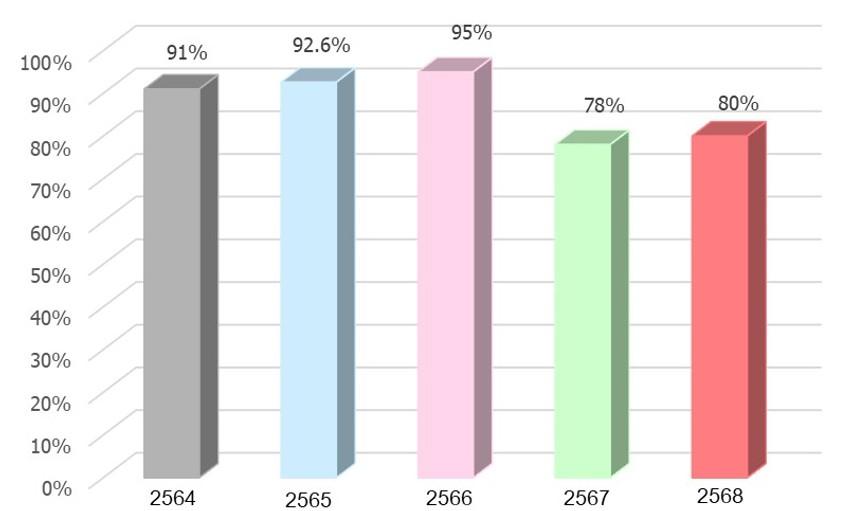
Organizational Overview
From the operational results in 2025, it was found that the overall satisfaction score of current customers was 80%. Compared to the previous year, this represents an increase. However, due to the company's revision of the assessment questions and the method of surveying satisfaction, which involved staff directly calling customers, some customers remained concerned about scammers and PDPA regulations, leading to incomplete data. Although the score improved, the proportion of respondents decreased.
Customer Satisfaction Development Plan
To elevate service quality and further improve product quality, as well as to enhance customer satisfaction, especially after title transfer, the customer satisfaction development plan is outlined as follows:
-
Developing the project's after-sales service team to inquire about and recommend services to existing residents, in order to build good relationships with customers. This also includes continuously preparing public relations letters to inform them about the progress of common area usage and the shared utilization of common utilities, to create a pleasant community. Additionally, publicizing activities from Chewathai Society in each project will further foster good relationships between the project and its customers.
-
Developing repair notification services by establishing the Chewa Care team to coordinate appointments, inspect, and schedule repairs at the customer's convenience, and to coordinate with the project for repairs to be carried out as scheduled. Additionally, repaired work will be re-inspected with the homeowner to verify work quality and initial satisfaction, with immediate rectification if the work is not satisfactory. Furthermore, emphasis is placed on the contractor team to select experienced and skilled workers to perform repairs for customers, and contractors will be evaluated by relevant agencies to ensure continuous improvement, development, and retention of good contractors to work with the project.
-
Developing diverse channels for customer satisfaction surveys to reach more customers, including an online survey system for project visitors. Additional communication will be conducted via LINE@, E-Mail, and SMS, by developing a CRM system to automatically evaluate results at various interaction points with the company. This aims to obtain reliable and accurate satisfaction scores, which will lead to improved service quality. Furthermore, a system for processing satisfaction scores will be in place, allowing data to be used immediately for satisfaction enhancement.
-
Developing and improving construction processes to meet standards and enhance customer safety. This involves enhancing construction processes by adding steps for product quality inspection or QC checks before delivering products to customers, thereby increasing customer confidence and satisfaction.
The company is committed to developing and improving the quality of its excellent products and services for delivery to customers, thus prioritizing customer satisfaction. For the upcoming year, the goal is to further increase customer satisfaction scores.
Community & Social — Plan & Guidelines
Has a Community & Social Plan
Yes
Plan Description
Community Support Project for Local Employment
1. Principles and Rationale
Chewathai Public Company Limited recognizes the importance of conducting business alongside sustainable community development, especially in the areas surrounding its projects. The company supports local employment in nearby project areas for permanent cleaning staff, which is one way to generate income for households in the community, reduce unemployment, and foster good relationships between the organization and the community. This project aligns with the concept of social responsibility ( CSR) and principles ESG in the social dimension ( Social) which focuses on improving the quality of life for people in the area
2. Project Objectives
2.1 To create employment opportunities for people in areas near the project
2.2 To promote income and quality of life for households in the community
2.3 To foster good relationships and cooperation between the company and the community
2.4 To reduce employee travel from remote areas and reduce indirect greenhouse gas emissions ( Indirect Emissions)
3. Operational Guidelines The company has established clear operational guidelines as follows:
3.1 Prioritize job applications from individuals residing in areas near the project
3.2 Determine compensation and benefits according to labor law standards
3.3 Continuous monitoring, evaluation, and skill development
4. Performance Results for 2025
Out of a total of 17 permanent housekeepers, they work in 14 projects, including both low-rise and high-rise projects. The proportion of housekeepers who are local residents in areas near the project is 100% (measured within a 20 km radius). Employee retention rate ( Retention Rate) 90% (1 employee resigned)
5. Positive Social and Environmental Impacts
Social Impact
-
Generate income and economic stability for households in the area
-
Strengthen good relationships between the company and the community
-
Reduce unemployment rate in areas around the project
Environmental Impact ( Indirect Impact)
-
Reduce travel distance for employees from remote areas
-
Reduce indirect greenhouse gas emissions ( Scope 3)
6. Positive Impacts on Stakeholders
for the community
-
Generate circulating income in the local economy
-
Increase sense of participation and ownership of the area
for residents/occupants
-
Receive services from personnel who understand the local context
-
Enhance a friendly and safe atmosphere within the project
for the organization
-
Build a corporate image of social responsibility
-
Build trust and long-term relationships with the community
7. Integration with Strategy ESG
The project aligns with the strategy ESG of the company in the social dimension ( Social) by focusing on
-
Creating Shared Value ( Shared Value) between the organization and the community
-
Reducing economic inequality in areas around the project
-
Improving the quality of life for stakeholders
-
Support for local employment ( Local Employment)
The company implements a project to employ local residents around its projects as housekeepers, under the concept of "Growing Together with the Community," to create shared value within the framework of ESG Social Aspect ( Social) The project aims to create employment opportunities, support household income, and reduce inequality in the community. The company sets strict work standards, provides skill development training, and adheres to labor laws. Local employment helps strengthen community relations, increases resident satisfaction, and builds a responsible corporate image, while also contributing to reduced travel and supporting the organization's long-term environmental goals.
Plan Areas
| Plan Area |
|---|
| Employment and professional skill development |
| Education |
| Water and sanitation management |
Community & Social — Targets
Has Set Community & Social Targets
No
Community & Social — Performance & Outcomes
Has Performance Results
Yes
Performance Description
Performance results for 2025 of Local Employment Community Support Project
Out of a total of 17 permanent housekeepers, working across 14 projects, including both low-rise and high-rise developments. The proportion of housekeepers who are local residents near the project area is 100% (measured within a 20-kilometer radius). Employee retention rate ( Retention Rate) 90% (1 employee resigned)
Other Sustainable Community Support Projects
-
Chewathai Public Company Limited has continuously supported Ban Pa Lao School in Lamphun Province for the 9th consecutive year. This support includes funding for core subject teachers, promoting local culture through community sages, and providing financial assistance for education, sports, and the development of school buildings, in collaboration with business partners. In 2025, the company delivered sets of school desks made from used cardboard boxes, donated by Chewathai residents from all projects, in cooperation with SCGP. This reflects the efficient use of resources alongside the creation of sustainable educational opportunities. This year, Chewathai continues to pursue this commitment to continuously develop remote communities.
-
Chewathai Public Company Limited, in collaboration with business partners, organized an activity to deliver drinking water and essential supplies to assist flood victims in the southern region. Chewathai employees collectively worked to transport and deliver aid to donation points urgently, reflecting the power of cooperation and the commitment to stand by communities during times of crisis.
Law Violation Incidents
Law Violation Incidents
| Metric | Current Year | Previous Year | Two Years Ago |
|---|---|---|---|
| The total number of cases or incidents of significant violations of laws or regulations regarding social and human rights (Cases) | 0 | 0 | 0 |
| The total number of cases or incidents that cause significant labor disputes (Cases) | 0 | 0 | 0 |
| The total number of cases or complaints related to consumer rights violations (Cases) | 0 | 0 | 0 |
| The total number of cases or complaints related to partner rights violations (Cases) | 0 | 0 | 0 |
| The total number of cases or incidents that cause disputes with the community/society (Cases) | 0 | 0 | 0 |
| The total number of cases or incidents related to cyber security or customer data breaches (Cases) | 0 | 0 | 0 |
| The total number of cases or incidents related to safety and occupational health at work (Cases) | 0 | 0 | 0 |